
Services / Polymer synthesis & development
Polymer synthesis & development for advanced materials
NIRI provides specialist polymer synthesis and development services for organisations developing fibres, nonwovens and advanced materials. Our chemists, materials scientists and engineers combine polymer knowledge with practical expertise in synthesis, compounding, fibre formation, nonwoven processing and product development.
This enables us to support projects from early-stage monomer and polymer development through to fibre production, prototyping, testing and manufacturing scale-up.
From molecule to material
The performance of a fibre or nonwoven product starts with its chemistry. NIRI helps clients understand and control the relationship between monomer chemistry, polymer structure, additives, processing definition and final material performance.
By applying polymer science expertise to a coordinated development approach that combines composition and processing choices, we can investigate how decisions made at the molecular level affect fibre formation and ultimately the performance of the finished product. Developments can consider:
- Monomer chemistry and purity
- Polymer structure and molecular properties
- Polymerisation conditions
- Additives and functional compounds
- Thermal behaviour, rheology and processability
- Fibre-forming performance
- Finished-material properties
This integrated approach enables potential technical risks to be identified earlier in the development process and allows us to identify development opportunities that may be missed when individual manufacturing stages are considered in isolation.

Sustainable polymer development
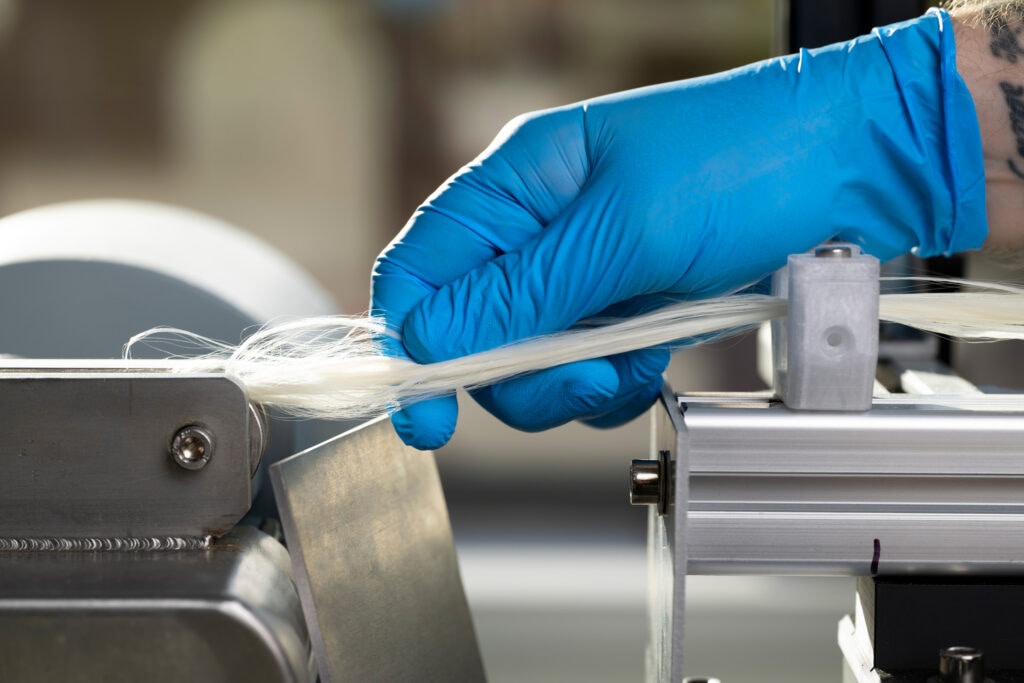
Polymer engineering is increasingly central to the transition towards lower-impact materials and more circular products. NIRI has experience developing and processing conventional polymers alongside bio-based and emerging biopolymers.
Our polymerisation and processing capabilities can support innovation involving:
- Bio-based and biodegradable polymers
- Renewable and fermentation-derived monomers
- Recycled polymer feedstocks
- Fibre-to-fibre recycling
- Polymer reprocessing
- Reduced fossil-derived content
- Alternative polymer formulations
Crucially, we can evaluate not only whether a new polymer can be produced, but whether it can subsequently be processed into fibres, nonwovens and functional products.
In-house polymerisation facilities
NIRI’s polymerisation and chemistry facilities enable new polymer systems, experimental chemistries and recycled feedstocks to be investigated at laboratory scale, before progressing into fibre and nonwoven development. Our capabilities include:
- 20cc high pressure micro-reactor
- High-pressure polymerisation reactor
- Solid-phase polymerisation
- Emulsion and solution polymerisation
- Polymer compounding and masterbatching
- Pelletising and resin preparation
- Polymer and monomer characterisation
These capabilities can be combined with our fibre extrusion, nonwoven prototyping and analytical facilities, allowing projects to progress from polymer chemistry towards a functional material within one R&D environment.
Exploratory synthesis & rapid screening
Early-stage polymer development often involves working with small quantities of novel, expensive or difficult-to-obtain materials. NIRI’s micro-reactor enables gram-scale exploratory synthesis and rapid screening before larger quantities of material are required. This is particularly useful for evaluating:
- New monomers and polymer systems
- Recycled monomer streams
- Alternative formulations
- Polymerisation conditions
- Early-stage recycling technologies
- Emerging sustainable materials
Small-scale trials allow different approaches to be compared quickly. By designing experimental cycles to integrate with on-site polymer characterisation and prototype testing, we enable our clients to make informed development decisions while reducing material consumption and technical risk.
Feedstock & monomer characterisation
The purity and consistency of a monomer feedstock can have a significant impact on polymerisation and the performance of the resulting material, particularly when working with recycled or bio-derived feedstocks. NIRI can combine analytical characterisation with small-scale polymerisation to assess whether a recovered monomer or chemical intermediate is suitable for reuse, answering three key questions:
How pure is the feedstock?
Identify contaminants such as residual dyes, finishes, stabilisers, plasticisers, metals, moisture or solvents that could affect polymerisation or subsequent processing.
Can it be repolymerised?
Use small-scale polymerisation trials to assess processability and optimise reaction conditions.
Can the resulting polymer perform as required?
Characterise the polymer and, where appropriate, progress successful materials into fibre extrusion and subsequent product development.
This gives recycling technology developers a practical route to assess technical viability without needing to establish polymerisation, fibre-processing and analytical facilities in-house.
Fibre-to-fibre recycling & polymer circularity
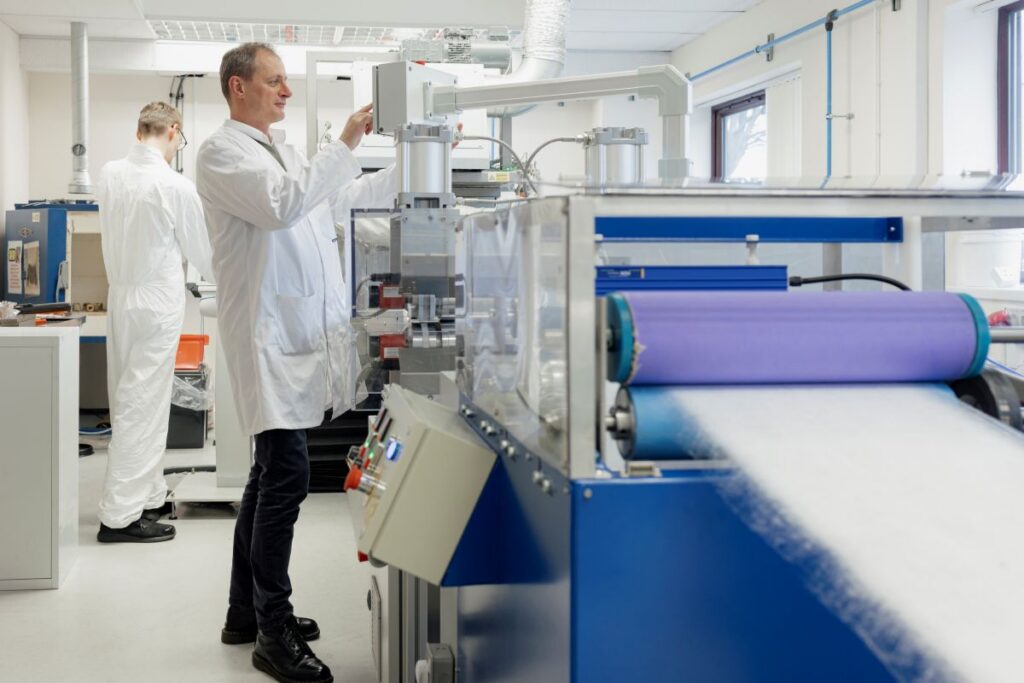
NIRI supports the development of fibre-to-fibre recycling technologies by linking recycling chemistry with polymerisation, fibre production and material testing. This can include chemical and enzymatic recycling routes, where textile polymers are broken down into monomers or chemical intermediates before being converted back into new polymers.
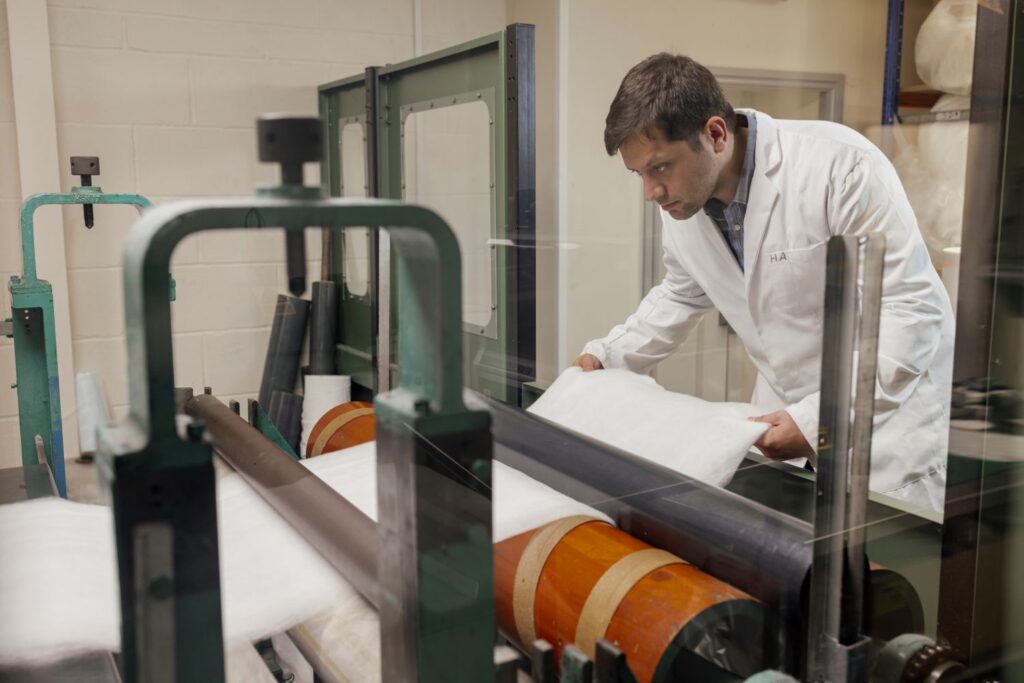
Successful materials can then progress into NIRI’s fibre extrusion facilities to assess whether the recycled polymer can be converted back into fibres with appropriate processing and performance characteristics. Subsequent application validation work can then be undertaken.
This creates an integrated development pathway. By connecting these stages, NIRI can help organisations evaluate whether an emerging recycling technology offers a technically viable route back into fibre production.
Polymer compounding & functionalisation
Polymer performance can also be tailored through compounding, blending and the incorporation of functional additives. NIRI can support the development of:
- Polymer blends
- Masterbatches
- Functional additives
- Compatibilisers
- Composite systems
- Alternative material formulations
This enables properties such as processability, functionality and finished-product performance to be optimised around the requirements of the intended application.
Polymer testing, characterisation & processability
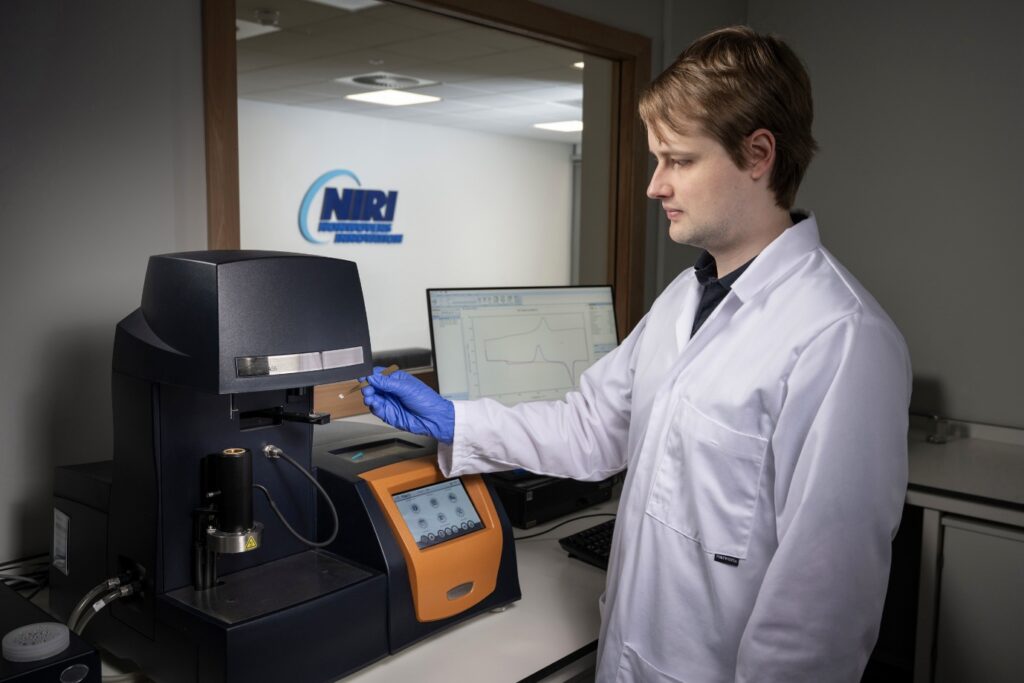
Understanding the thermal and chemical behaviour of a polymer is critical before progressing into fibre extrusion or other manufacturing processes. NIRI can investigate polymer chemistry, degradation, processing behaviour and performance using techniques including:
- Fourier Transform Infrared Spectroscopy (FTIR)
- Differential Scanning Calorimetry (DSC)
- Thermogravimetric Analysis (TGA)
- Microscopy
- Mechanical testing
- Thermal and chemical characterisation
- Potentiometric titration
- High pressure liquid chromatography
- UV spectroscopy
- Non-destructive moisture testing
- Rheology
These capabilities help establish appropriate processing conditions, identify degradation mechanisms and understand how changes in polymer chemistry and processing influence fibre formation and finished-material performance.
NIRI can also investigate existing polymers and formulations where processing or performance limitations have been identified, helping optimise areas such as melt processing, fibre formation, spin finishes, thermal stability, chemical compatibility and manufacturing consistency.
From polymer synthesis to fibre development
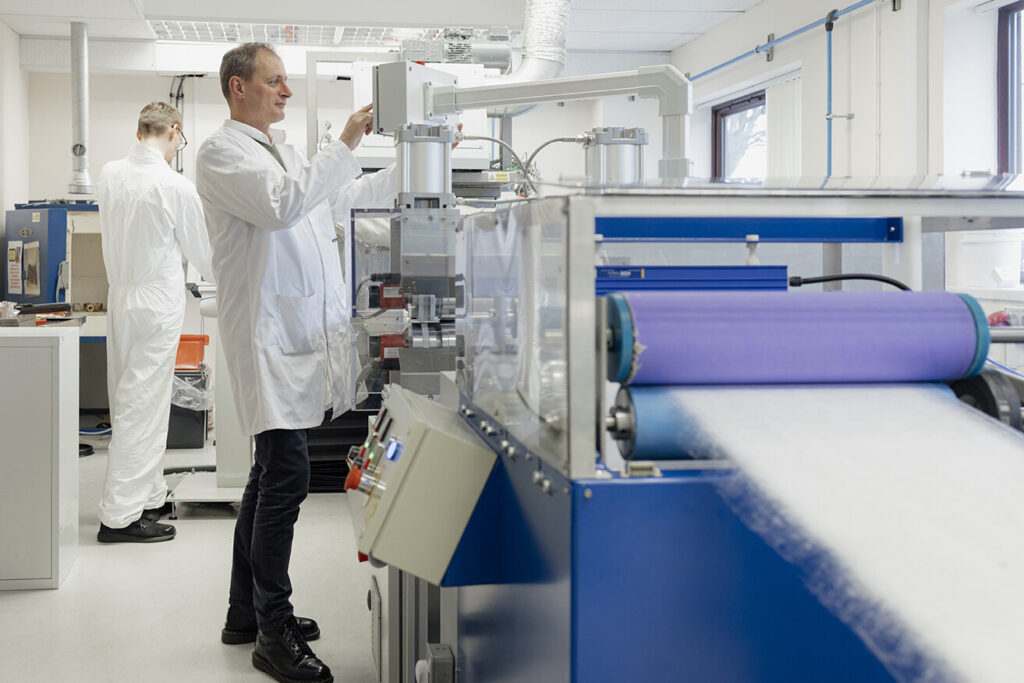
NIRI’s polymer capabilities form the first stage of a wider polymer-to-product development pathway. Successful materials can progress directly into our Fibre Extrusion & Spunmelt, where their fibre-forming behaviour, processability and performance can be evaluated before further nonwoven development, prototyping and scale-up.
Collaborate with us
Developing a new polymer, recycled feedstock or circular fibre technology?
Whether you are developing a new polymer, evaluating a bio-based alternative, improving the processability of an existing material or translating laboratory chemistry into a fibre or nonwoven product, NIRI can help bridge the gap between polymer science and commercial manufacture. Talk to NIRI about your polymer synthesis and development programme.